
Description
PrymaLab · Research Use Only
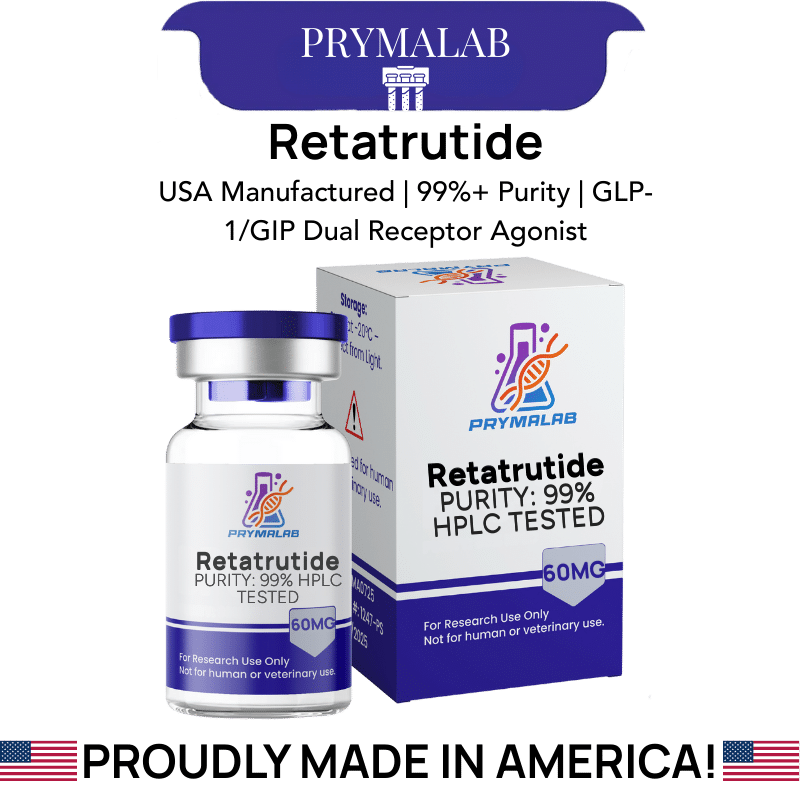
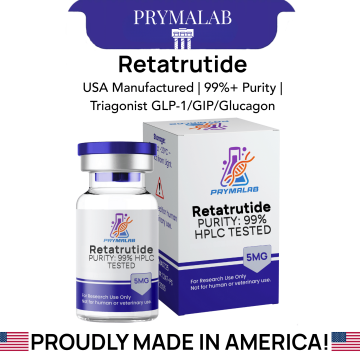
Retatrutide 60mg
LY3437943 · largest fill · single-lot continuity
Retatrutide 60mg is the largest fill in this range, a lyophilized vial of LY3437943, CAS 2381089-83-2, approximately 12.3 micromoles. A quantity this size commits a programme to a single synthesis lot, which is both the reason to buy it and the reason to verify it first.
Specification Table
| Property | Value |
|---|---|
| Compound | Retatrutide |
| Development code | LY3437943 |
| CAS number | 2381089-83-2 |
| Vial content | 60 mg lyophilized powder |
| Molar content at MW 4894.58 | Approximately 12.3 µmol |
| Potency spread across targets | Roughly two orders of magnitude, GIPR to GCGR |
| Molecular formula | C228H350N48O66 |
| Molecular weight | Contested. 4894.58 and 4731.33 both circulate. See the note on the 5mg page |
| Residue count | 39 |
| C-terminus | Amidated |
| Peptide backbone | Based on the GIP sequence rather than GLP-1 |
| Non-coded residue, position 2 | α-aminoisobutyric acid (Aib) |
| Non-coded residue, position 13 | α-methyl-leucine |
| Non-coded residue, position 20 | α-aminoisobutyric acid (Aib) |
| Lipid conjugation | Lysine 17 side chain bears PEG2-γ-Glu-eicosanedioic acid |
| Molecular targets | GIP receptor, GLP-1 receptor, glucagon receptor |
| Reported EC50, GIPR | 0.0643 nM |
| Reported EC50, GLP-1R | 0.775 nM |
| Reported EC50, GCGR | 5.79 nM |
| Originating organisation | Eli Lilly |
| Appearance | White lyophilized powder |
| Purity | Per lot-specific certificate of analysis |
| Solubility | Water soluble. Slightly alkaline buffer aids dissolution |
| Storage, lyophilized | -20°C, protected from light and moisture |
| Storage, reconstituted | 2-8°C, protected from light |
| Regulatory status | Investigational. No approved formulation in any jurisdiction |
What Do the Retatrutide Receptor EC50 Values Mean?
Three published potency figures define what Retatrutide 60mg does, and reading them together is more informative than reading any one.
The reported values are 0.0643 nanomolar at the GIP receptor, 0.775 nanomolar at the GLP-1 receptor and 5.79 nanomolar at the glucagon receptor. Coskun and colleagues published the characterisation.
The spread is roughly ninety-fold between the most and least potent target. That is not a rounding difference or an assay artefact; it is a deliberate feature of the design.
What it means practically is that receptor engagement is a function of concentration in a way that a single-target compound never is. At 0.1 nanomolar the molecule is essentially a GIP receptor agonist. At 10 nanomolar it engages all three.
An experiment reporting an effect at one concentration therefore describes a specific receptor combination, not the compound in general. Stating the concentration alongside these three values lets a reader reconstruct which receptors were plausibly engaged.
EC50 is also an assay-dependent quantity. Values obtained in different expression systems, with different reporter constructs and different receptor densities, are not directly comparable, and the figures above should be read as the primary characterisation rather than as constants.
Why Does Assay System Change the Numbers?
Potency figures for the same ligand at the same receptor vary between laboratories, and most of the variation is systematic rather than random.
Receptor density is the largest factor. A cell line overexpressing a receptor produces apparent potency higher than a system expressing it at native density, because spare receptors let a smaller fraction of occupancy drive a maximal response.
Readout choice contributes. A cyclic AMP accumulation assay measures an amplified second messenger and reports higher apparent potency than a proximal measurement such as receptor binding or G protein recruitment.
Incubation time matters for a compound with slow binding kinetics. Measuring before equilibrium underestimates potency, and lipidated peptides can approach equilibrium slowly.
Albumin in the assay medium shifts the free concentration downward, so a potency figure obtained in serum-containing medium understates the free-concentration potency unless the free fraction was measured.
The practical consequence is to compare figures obtained in the same system rather than figures obtained in the same units, and to state the system whenever a number is reported.
What Is the Regulatory Position?
Stating this precisely matters for a compound under active clinical development, because the situation is neither approved nor abandoned.
Retatrutide is investigational. It has progressed through clinical trials conducted by its developer, and results have been published in peer-reviewed journals including The Lancet and the New England Journal of Medicine.
No formulation is approved for any indication in any jurisdiction. Clinical trial activity and regulatory approval are different things, and the presence of published trial data does not imply the second.
Material offered as a research chemical is not the clinical formulation. It is synthesised independently, characterised to whatever standard the supplier applies, and supplied without the manufacturing controls a pharmaceutical product carries.
Those two facts together define what this product is: a research-grade preparation of a molecule that is under investigation elsewhere, sold for laboratory use.
Any description positioning it otherwise misstates its status, and the distinction is worth holding clearly given how the compound is discussed outside research contexts.
When Does the Retatrutide Bulk Vial Make Sense?
Retatrutide 60mg is a commitment and the reasoning should be explicit rather than a default toward the lowest unit price.
It makes sense where a programme is defined in advance and will run long enough that a lot change would otherwise fall inside it. Holding synthesis variation constant across a whole study removes a confound that is difficult to detect after the fact.
It makes sense for animal work, which consumes material at rates that turn repeated purchasing into an operational problem and a scheduling risk.
It makes less sense for exploratory work where the design is still moving, because a large quantity of one compound is only economical if the compound turns out to be the right one.
And it makes least sense where the material will be reconstituted in bulk, for the aggregation reasons set out on the 50mg page. The format rewards laboratories that divide dry powder and penalises those that do not.
A useful test: if the programme cannot state now how the vial will be divided, the smaller format is probably the better purchase.
What Applies to Buying Retatrutide Online in the USA?
Domestic sourcing raises questions that are practical rather than pharmacological.
Transit time is shorter, which matters less for lyophilized powder than for solution products but still reduces the window for a temperature excursion.
Documentation expectations differ. A domestic supplier is more likely to hold a certificate in a familiar format and to answer analytical questions directly, though neither follows automatically from location.
Import considerations do not arise, which removes a category of delay and a category of paperwork. For a research chemical this simplifies receiving rather than changing what arrives.
None of this substitutes for the certificate fields listed on the 40mg page. A domestic supplier without a chromatogram is not preferable to an overseas one with a full analytical package.
Location is a convenience factor. Characterisation is the quality factor, and conflating the two is the most common error in sourcing decisions for this compound class.
What Does Retatrutide 60mg Represent in the Range?
Twelve point three micromoles is the largest fill offered here and the decision to take it should be deliberate.
Retatrutide 60mg is a programme commitment rather than a stock purchase. Everything drawn from it shares one synthesis history, one impurity profile and one set of whatever went slightly wrong during coupling.
That shared history is an advantage for comparability and a liability for risk concentration, and the balance tips on whether the lot is verified before use.
Where a study is defined, scheduled and long, Retatrutide 60mg is the correct choice and the lower unit cost is a secondary benefit rather than the reason.
Where the design is still moving, a smaller fill preserves the option to change compound without stranding material.
How Should the Largest Fill Be Handled?
With Retatrutide 60mg: verify first, divide dry, reconstitute only what will be used.
Independent verification before the first experiment is more important here than anywhere else in the ladder, because more work depends on this single lot than on any other vial in the range.
Divide the powder using an analytical balance with static control. Sixty milligrams split into six portions of ten leaves five in the stable dry state while the sixth is in use.
Where full reconstitution is required, 12 ml gives roughly 1.02 mM and keeps arithmetic consistent with every other format here.
Aliquot, freeze, thaw once, inspect for clarity before use. The aggregation mechanism does not change with vial size but the consequences of ignoring it scale with the quantity committed.
Record everything: lot, verification results, molecular weight used, each mass weighed with its date, diluent, volume, measured concentration, aliquot scheme and freeze-thaw history. At 12.3 micromoles spread across a programme, the record is the only thing linking a late finding to the material behind it.
A final note on comparing published potency figures against your own. If your measured EC50 differs from the published one by several fold, the first thing to check is receptor density rather than the compound.
Overexpressing lines routinely report potency an order of magnitude higher than native-density systems, and that difference is systematic rather than error.
Reporting the expression system alongside the number lets someone else make that adjustment instead of guessing at it.
A last point on the three receptors and interpretation. Because the potency spread is wide, a concentration chosen for convenience rather than by design will usually sit in the range where two receptors are saturated and one is partly engaged.
That is the least interpretable position available, and choosing concentrations against the published values rather than against habit avoids it.
A closing note on splitting a fill between collaborators. Dividing dry powder and shipping portions preserves the lot-continuity advantage across sites, which is the main reason to buy at this scale in the first place.
Shipping reconstituted portions undoes much of that advantage, because each transit leg adds interface exposure and thermal swings the dry powder would never have met.
Published Literature
References verified against the publisher record. The receptor potency figures above come from the primary characterisation and should be read with the assay-dependence caveat discussed in the sections.
- Coskun T, Urva S, Roell WC, Qu H, Loghin C, Moyers JS, O’Farrell LS, Briere DA, Sloop KW, Thomas MK, Pirro V, Wainscott DB, Willard FS, Abernathy M, Morford L, Du Y, Benson C, Gimeno RE, Haupt A, Coskun T. Cell Metabolism. 2022;34(9):1234-1247.
- Urva S, Coskun T, Neff LM, Yeo KP, Loghin C, Ma X, Landry J, Bray R, Milicevic Z, Haupt A. The Lancet. 2022;400(10366):1869-1881.
- Jastreboff AM, Kaplan LM, Frias JP, Wu Q, Du Y, Gurbuz S, Coskun T, Haupt A, Milicevic Z, Hartman ML. New England Journal of Medicine. 2023;389(6):514-526.
- Willard FS, Douros JD, Gabe MB, Showalter AD, Wainscott DB, Suter TM, Capozzi ME, van der Velden WJ, Stutsman C, Cardona GR, et al. JCI Insight. 2020;5(17):e140532.
- Finan B, Yang B, Ottaway N, Smiley DL, Ma T, Clemmensen C, Chabenne J, Zhang L, Habegger KM, Fischer K, et al. Nature Medicine. 2015;21(1):27-36.
Frequently Asked Questions
What is Retatrutide 60mg?
The largest fill in this range, a lyophilized vial of LY3437943, CAS 2381089-83-2, approximately 12.3 micromoles. A quantity this size commits a programme to a single synthesis lot.
What are the reported EC50 values?
Zero point 0643 nanomolar at the GIP receptor, 0.775 at the GLP-1 receptor and 5.79 at the glucagon receptor. That is roughly a ninetyfold spread between the most and least potent target.
Is that spread accidental?
No. It is a deliberate feature of the design rather than a rounding difference or assay artefact. Optimising affinity at one receptor in this family typically costs affinity at another, and this is where the compromise landed.
What does the spread mean practically?
That receptor engagement depends on concentration in a way a single-target compound never does. Around 0.1 nanomolar the molecule is essentially a GIP receptor agonist. Around 10 nanomolar it engages all three.
Why do EC50 values differ between laboratories?
Mostly systematically. Receptor density is the largest factor, since overexpressing systems show higher apparent potency through spare receptors. Readout choice, incubation time and albumin content all contribute as well.
How should potency figures be compared?
By comparing figures obtained in the same system rather than the same units, and by stating the system whenever a number is reported. EC50 is assay-dependent rather than a constant of the molecule.
What is the regulatory position?
Investigational. The compound has progressed through clinical trials with results published in peer-reviewed journals, and no formulation is approved for any indication in any jurisdiction. Trial activity and approval are different things.
Is research material the clinical formulation?
No. It is synthesised independently, characterised to whatever standard the supplier applies, and supplied without the manufacturing controls a pharmaceutical product carries. The two are not interchangeable.
When is the bulk vial the right choice?
When a programme is defined in advance, will run long enough that a lot change would otherwise fall inside it, and the laboratory can divide dry powder accurately. If the division plan cannot be stated now, a smaller format is better.
Does domestic sourcing improve quality?
Not by itself. It shortens transit and simplifies receiving, but a domestic supplier without a chromatogram is not preferable to an overseas one with a full analytical package. Location is convenience; characterisation is quality.
What should be verified before the first experiment?
Mass by high-resolution mass spectrometry and purity by a well-resolved chromatogram, plus confirmation of the lipid conjugation and the non-coded residues. More work depends on this lot than on any other vial in the range.
Compliance Statement
Retatrutide 60mg is sold exclusively for laboratory research use. It is not a drug, food, or cosmetic product, and it is not a dietary product of any kind. It is not approved by the FDA or any comparable authority for human or veterinary use, it is an investigational compound with no approved formulation in any jurisdiction, and material supplied as a research chemical is not a clinical product. This product is not intended to diagnose, treat, cure, or prevent any disease. It must not be given to humans or animals. Purchase is restricted to qualified researchers and institutions operating within applicable laws. All handling is the responsibility of the purchasing laboratory.












18 reviews for Retatrutide 60mg